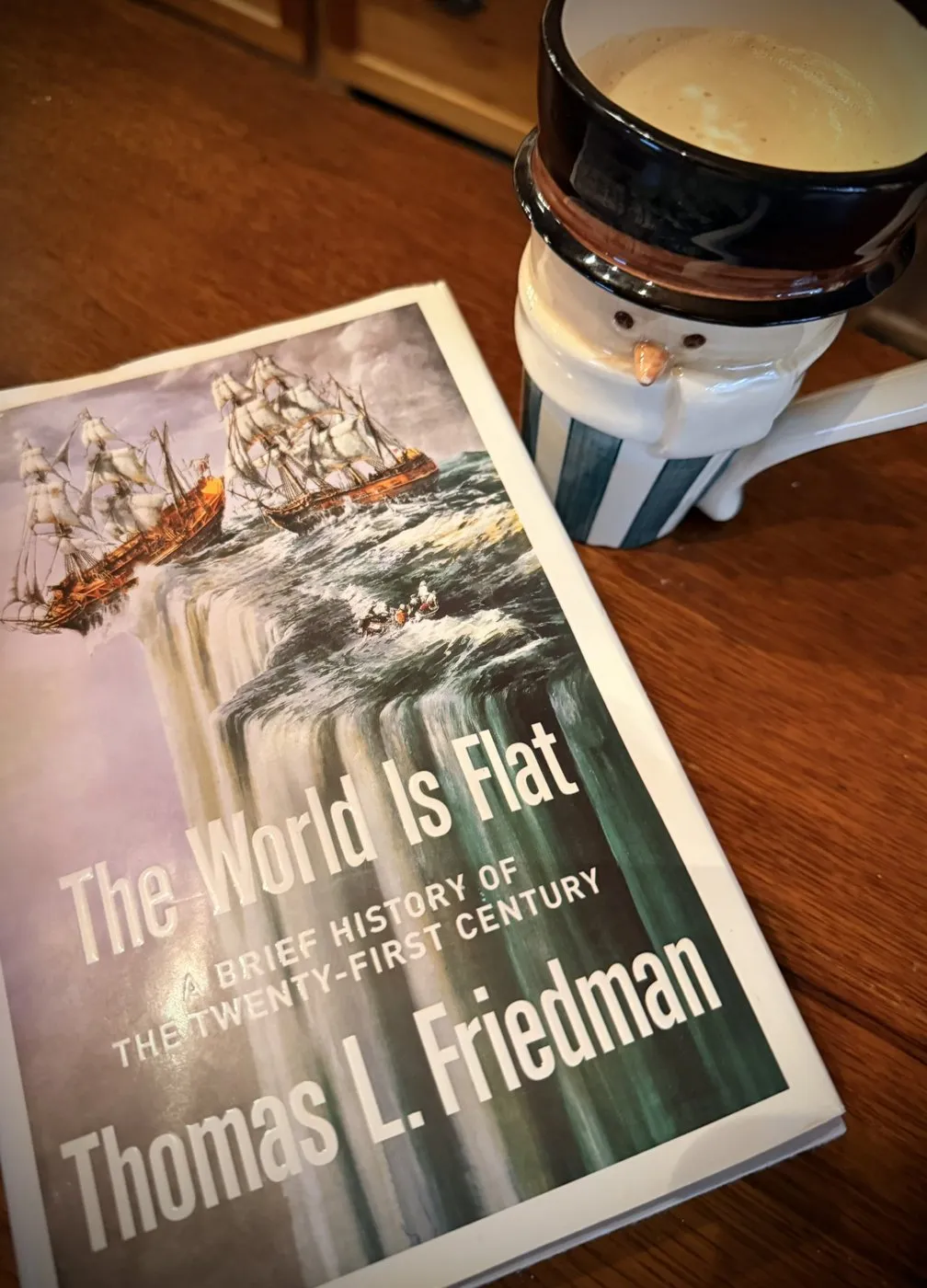
Book review: The World Is Flat
Mr. Thomas Friedman assures us that the world is flat. He means, of course, that systems have equalized, that technology has planed the rough edges of geography, culture, and fate, and that humanity may now proceed as a single, interoperable mechanism.
It is an attractive error.
It is also a dangerous one.
The Earth, to begin with, is round—not merely in the astronomical sense, but in its moral and human dimensions. It curves. It resists straight lines. It returns consequences. One may march confidently forward only to discover, to one’s surprise, that one has arrived again at the starting place—older, wearier, and no wiser for having ignored the terrain.
What Mr. Friedman mistakes for flattening is merely connectivity. Wires do not civilize. Bandwidth does not ennoble. Efficiency does not educate the soul. To confuse the circulation of information with the formation of wisdom is the signature error of the technocrat.
Humanity does not scale like software.
The West—when it was at its best—understood this. Its greatness did not arise from uniformity, but from creative dissent: from monasteries arguing with kings, from artists mocking empires, from saints irritating bureaucrats, from inventors who built first and explained later. Men such as Chesterton and Belloc saw clearly that life flourishes not under systems that promise inevitability, but under traditions that permit surprise.
The human spirit is not flat.
It is amorphous.
It bulges in unexpected places. It thins where theory expects strength. It erupts, recedes, contradicts itself, and refuses to be graphed for long. Any worldview that requires humanity to behave predictably in order to function is already in error. Life is not a supply chain.
Indeed, the most catastrophic approaches to life have always been monolithic. They insist on one model, one future, one optimization. They cannot tolerate exception, and so they persecute it. They cannot endure mystery, and so they declare it solved. They promise harmony and deliver sterility.
What astonishes me is not that modern men err, but that they err having inherited better tools. We laid foundations precisely to guard against this: pluralism without relativism, progress without inevitability, order without flattening. And yet these gifts are discarded in favor of dashboards, metrics, and the comforting fiction that history now runs on rails.
The Earth is round because reality pushes back.
Humanity is amorphous because freedom leaks.
To deny either is to mistake a temporary convenience for a permanent truth. The world is not flat. It is contoured, contradictory, and gloriously resistant to management. And that resistance is not a flaw—it is the very condition of human dignity.
Flatten the world, and you must first flatten the soul.
When men insist the world is flat, they begin building roads that permit no detours. And it is along such roads that the spirit is most efficiently lost.
Reviewed: Thomas L. Friedman, The World Is Flat: A Brief History of the Twenty-First Century (Farrar, Straus and Giroux, 2005).
Letters on this article
None yet.
Disagree, or know something we missed? Write a letter. Letters are read, held for at least three days, and published in a weekly batch.